
Roospin Trust and Licence in Australia: ACMA Status, Safety Signals and Complaints
 Available in US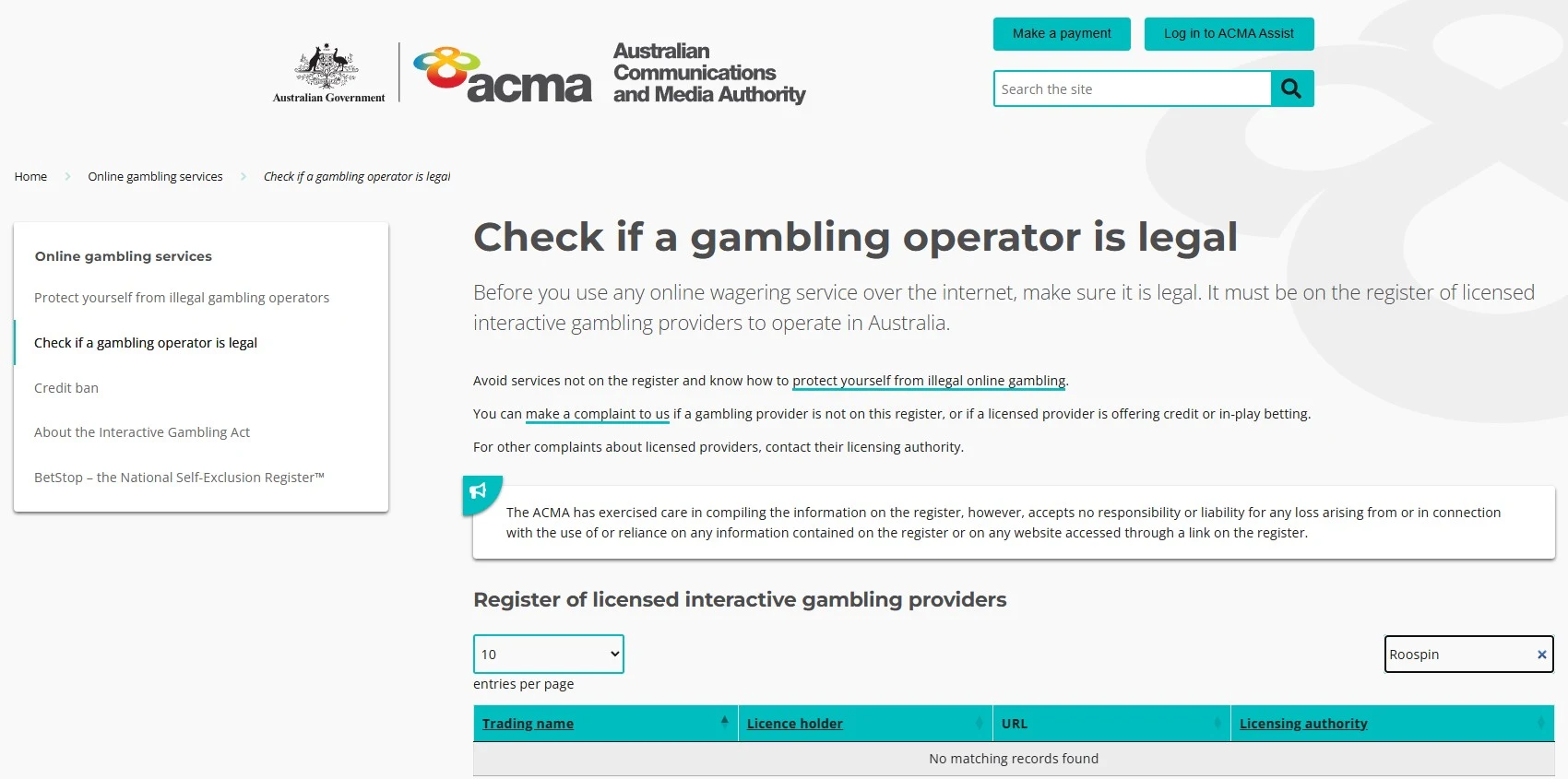
Table of content
Roospin is not listed under either Roospin or Roospin Entertainment on the ACMA register of licensed interactive gambling providers. That matters because ACMA states that online casino services are prohibited from being offered to people in Australia under the Interactive Gambling Act 2001. At the same time, operational access, offshore licensing claims and Australian authorisation are different questions. Roospin-focused sources refer to Curaçao and Philippine or PAGCOR licensing, but those claims conflict and do not provide a verified offshore licence number that should be presented as settled fact. For an Australian reader, the strongest trust assessment therefore starts with the regulator position, then looks separately at complaint evidence, account controls, payment behaviour and the limits of offshore protections.
Australian authorisation and operational access are not the same thing
A casino can be reachable from an Australian internet connection without being an Australian-licensed wagering provider. It can also accept account registrations or display Australian-dollar payment options without appearing on the ACMA register. Those facts describe technical or commercial access. They do not create an Australian licence.
For Roospin, the ACMA register is the decisive source for the local-licence question. Searches of the register do not return Roospin or Roospin Entertainment. The practical conclusion is narrow but important: there is no verified Australian register entry for Roospin. It would be inaccurate to stretch that into a claim that ACMA has approved the casino, that Australian licensing protections apply to the account, or that a functioning sign-up flow proves local authorisation.
This distinction also prevents the opposite mistake. A missing register entry is not, by itself, proof about every operational feature. The Roospin review can discuss the product that Australian-facing users encounter, while licensing should be judged against the regulator record rather than inferred from currency, language, payment availability or website access.
What Australian law says about online casino services
Australia’s federal framework for interactive gambling is the Interactive Gambling Act 2001, administered and enforced by the Australian Communications and Media Authority. ACMA guidance says that the Act makes it illegal for gambling providers to offer certain online services to people in Australia. Its list of banned services expressly includes online casinos. The rules focus on the provider offering the prohibited service, so the legal analysis should not be reduced to a simplistic statement about whether an individual player can open a webpage.
The same framework also restricts advertising of prohibited interactive gambling services in Australia. That regulatory context is one reason a trust assessment should not treat a polished website, promotional banner or Australian-dollar cashier as evidence that a service is locally authorised. The relevant question is whether the provider is permitted to offer the service under the Australian regime, and the ACMA register is the practical verification tool for licensed interactive wagering providers.
ACMA also uses enforcement measures against illegal gambling services, including website blocking. Its published material warns that illegal online gambling services may not provide the consumer protections available through legal services. That is a meaningful risk signal for Australians comparing offshore casino access with locally licensed wagering products.
Why offshore licence references need careful wording
Public descriptions of Roospin’s offshore licensing are inconsistent: some refer to Curaçao, while others refer to the Philippines or PAGCOR, and another source disputes the licensing presentation. With no licence number confirmed through an authoritative register or operator licence page, the specific offshore jurisdiction remains unclear.
This is not a semantic detail. A jurisdiction name, a licence number and an active regulatory status are three different pieces of information. Mentioning a jurisdiction alone does not prove that a licence is active, identify the legal entity that holds it or establish what complaint and dispute mechanisms apply to a particular player account.
For an Australian reader, even a genuine offshore licence would also be separate from Australian authorisation. An offshore regulator’s rules may govern the operator in its licensing jurisdiction, while ACMA determines whether the service can lawfully be offered to people in Australia under the federal interactive gambling framework. One status should never be used as a substitute for the other.
How to read Roospin complaint evidence
Complaint records are useful when they are treated as evidence about process rather than proof of a sweeping accusation. Casino Guru shows Roospin with a 3.5 “Low” Safety Index in its complaint context. One published Australian case concerned a withdrawal of A$30 that remained in processing while the player reported a lack of communication. The case was ultimately closed because the player stopped responding to the complaint process.
That case is relevant because it shows the type of friction a player may encounter around withdrawal status and communication. It does not prove that every Roospin withdrawal is delayed, that the operator refuses to pay players generally or that a specific cause applies to every case. Complaint portals also reflect only the cases submitted to them, and their scoring systems are third-party methodologies rather than regulator findings.
The useful response is to build evidence around an individual account. Keep withdrawal timestamps, transaction references, support transcripts and any verification requests. The withdrawal checks explain how to separate payment status, KYC and support follow-up without relying on an unsupported universal payout time.
Safety is a stack of signals, not one badge
There is no single icon or review score that can answer “Is Roospin safe?” for every Australian user. A more useful assessment separates several layers. The first is regulatory status: Roospin is not on the ACMA licensed-provider register. The second is the legal environment: ACMA says online casino services are prohibited from being offered to people in Australia. The third is operator transparency, including whether licensing information can be independently verified. The fourth is operational behaviour, such as how clearly payments, verification and complaints are handled.
Account security is another layer. Use unique credentials, keep control of the registered email account, avoid sharing verification documents outside the casino’s official account or support environment, and treat unsolicited contacts claiming to be support with suspicion. These are basic controls, but they matter more when an account sits outside the familiar Australian licensed wagering framework.
Game presentation is not a regulatory proxy either. A recognisable studio or professional-looking live dealer lobby can tell you something about the product catalogue, not the licence status of the casino account. The live casino is useful for understanding the game offering, while the trust decision still depends on separate regulatory and account-level evidence.
BetStop has a specific scope
BetStop is Australia’s National Self-Exclusion Register. It allows people to self-exclude from Australian licensed online and phone wagering providers in one process. BetStop’s own guidance is explicit that it does not apply to online casino games or other gambling services that are illegally provided in Australia.
That means BetStop should not be described as a universal block against every gambling website accessible from Australia. It covers the licensed wagering providers within the Australian system. There is no basis to imply that registering with BetStop necessarily creates an account block at Roospin.
For anyone who wants to stop or reduce gambling, the limitation is practical rather than theoretical. A national self-exclusion tool can be highly useful within its coverage, but other controls may still be needed for services outside that scope. Gambling Help Online provides free, confidential support across Australia 24 hours a day, including online counselling and information about additional ways to reduce access and manage gambling behaviour.
Registration and identity checks do not establish regulatory approval
A casino asking for identity verification can look like a sign of formal oversight, but KYC and licensing answer different questions. Operators may use identity checks for account security, payment controls, age checks or internal compliance processes regardless of whether they hold an Australian licence.
The verification therefore avoids presenting Roospin’s account checks as evidence of Australian authorisation. It also avoids publishing a fixed KYC document list or guaranteed verification time because those exact details have not been confirmed from a primary Roospin source. If verification is requested, the live account instructions are more reliable than a static checklist copied from a third-party review.
For trust purposes, the more informative question is whether the operator communicates clearly about what is required, whether requests are proportionate to the account action and whether support can explain a stalled review. Those are observable process signals that can be documented if a dispute develops.
Australian tax treatment is separate from casino legality
Tax is another area where unrelated questions are often mixed together. Australian Taxation Office guidance indicates that betting and gambling wins are generally not assessable income for an ordinary recreational gambler. The treatment can differ when gambling activity amounts to carrying on a business. That is a tax distinction about the player’s circumstances, not an endorsement of a particular gambling provider.
It would therefore be misleading to describe Roospin winnings as “tax free” in a blanket sense. The general recreational-player rule does not prove that every person’s facts are the same, and it does not convert an offshore casino into an Australian-authorised service. Anyone whose gambling is organised, commercial or otherwise unusual should rely on ATO guidance or professional tax advice for their own circumstances.
The 2027 reforms are important, but they begin on 1 January 2027
On 19 August 2026, the Australian Parliament passed the Interactive Gambling Amendment (Gambling Reform) Bill 2026. The Act received assent on 26 August 2026. ACMA says most of the reforms commence on 1 January 2027, including changes involving gambling advertising, enforcement tools, BetStop and related protections.
The reforms take effect from 1 January 2027, so measures tied to that commencement should not be described as operating before that date. The existing Interactive Gambling Act framework and ACMA guidance remain the basis for the Australian position until individual reforms commence.
This is also a reminder that regulatory settings should be assessed against ACMA guidance, the licensed-provider register and the implemented reform framework applicable at the time of the decision.
What Australian consumer protections can and cannot be assumed
When a provider is on the Australian licensed interactive wagering register, users can identify the licence holder and licensing authority through ACMA’s register. BetStop also operates across Australian licensed online and phone wagering providers. Those are concrete pieces of the domestic protection framework.
Roospin’s absence from that register means those protections should not be assumed to attach to the account simply because the site is accessible or uses familiar payment methods. A user should not assume that an Australian state or territory wagering authority supervises the casino, that a domestic complaints body has jurisdiction over every dispute or that BetStop will automatically prevent access.
That does not justify inventing a conclusion about what every offshore dispute process looks like. Because the offshore licence picture remains conflicting, the safest practical standard is to require verifiable operator information before relying on a regulator-specific remedy. If a licence jurisdiction or number is shown in the live Roospin interface, it should be checked against the relevant regulator rather than accepted at face value.
Trust checks to make before depositing
Start with the regulatory layer. Check ACMA’s licensed-provider register and keep the result separate from any offshore licence claim. Then inspect the account environment itself: confirm the domain, use the live cashier rather than an old review table, and read the withdrawal and verification terms that are actually presented to the account.
Before depositing, decide how much uncertainty you are willing to accept. The strongest caution signals here are the lack of an Australian register entry, ACMA’s prohibition on online casino services being offered to people in Australia, conflicting offshore licensing references and a low third-party complaint safety score. None of those should be hidden behind a generic statement that the site “works in Australia.”
If you proceed despite those signals, keep transaction evidence from the beginning. Use account-holder payment details, save confirmations, document support conversations and avoid allowing a small initial withdrawal to become a test of money you cannot afford to lose. Operational convenience is not the same as enforceable protection.
Where Roospin stands for Australian players
The clearest verified point is that Roospin is not listed under the searched names on ACMA’s register of licensed interactive gambling providers. ACMA also states that online casino services are among the interactive gambling services prohibited from being offered to people in Australia. Those facts make Australian authorisation a weak point in any trust assessment.
Offshore licence references do not repair that gap because the available Roospin sources conflict between Curaçao and Philippine or PAGCOR claims, and no licence number has been independently verified here. Complaint evidence adds another caution signal, particularly the 3.5 Low Casino Guru Safety Index and the published delayed-withdrawal case, but a single complaint should not be turned into a claim of systematic fraud or non-payment.
The useful decision framework is therefore layered. Treat ACMA status as the Australian regulatory answer, offshore licensing as unresolved until independently verified, complaint portals as secondary evidence, and account behaviour as something to document carefully. BetStop remains valuable for Australian licensed wagering providers but should not be assumed to cover Roospin, while Gambling Help Online remains available nationally for anyone who wants support. That separation of issues produces a more accurate answer than either a blanket “safe” label or an unsupported claim about every possible user outcome.