
Roospin Payments Australia: AUD Deposits, PayID, POLi and Cards
 Available in US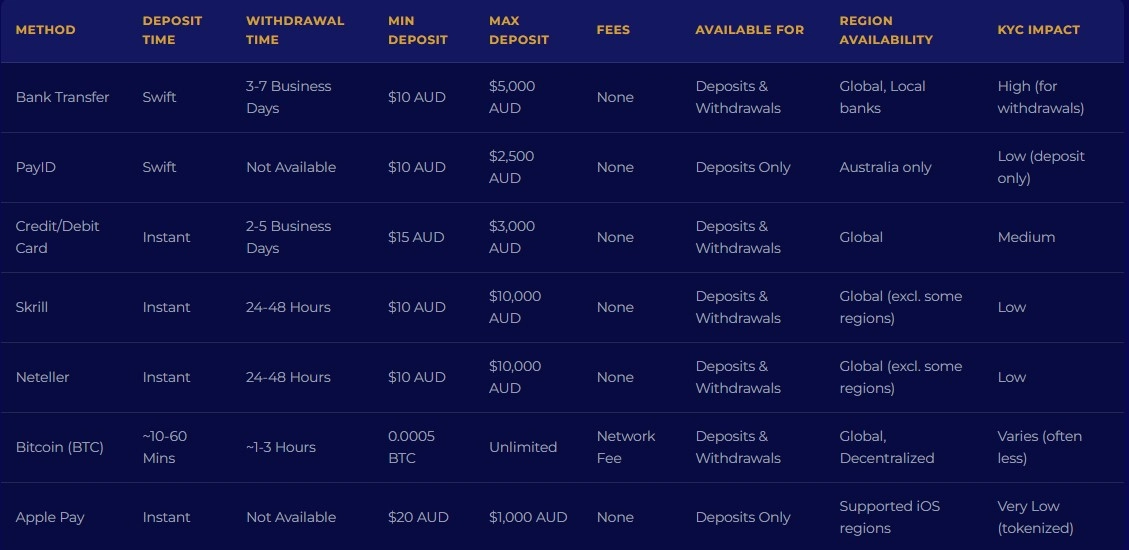
Table of content
For the wider product context, see the Roospin review. Roospin-focused Australian sources consistently describe an AUD cashier with PayID, Visa and Mastercard, bank-transfer style options and cryptocurrency. For an Australian user, PayID is the most locally relevant choice because it moves money through an account-to-account rail already familiar to a large share of consumers. The important exception is POLi: some Roospin guides still list it, but Australia Post closed POLi Payments in Australia in September 2023. That means POLi should not be treated as a dependable live option simply because it appears in a casino payment table. The practical approach is to open the cashier, confirm what is actually presented for the account, and prefer a method that matches the user’s banking habits and likely cashout route. The focus here is on deposits. Cashout, verification and processing-risk guidance is covered separately in the withdrawals.
AUD support is the starting point
Roospin is presented to Australian users with Australian dollars as a supported account currency. That matters more than it may first appear. A player who deposits in the same currency used for the account can read deposit values, bonus thresholds and account balances without mentally converting from euros or US dollars. It also separates casino-side denomination from any charges that might still arise at a bank, card issuer or cryptocurrency network.
AUD support does not mean every funding rail is automatically local, nor does it mean every listed method will be enabled for every account. Payment availability can change by country, provider, transaction type and account status. The cashier therefore has to be treated as the operational source at the moment of deposit. A static review can identify the main categories and the most useful Australian context, but it should not promise a universal list of methods, exact fees or fixed limits.
For first-time users, that distinction is especially important when a deposit is connected to a promotion. The welcome bonus explains the bonus structure separately. A payment method can be available for ordinary funding without necessarily being eligible for every promotion, and a promotional minimum should not be confused with a cashier-wide minimum.
Why PayID stands out for Australians
PayID is the clearest local banking angle in Roospin’s Australian payment coverage. The service lets users send money using an identifier such as a mobile number or email address rather than relying only on a BSB and account number. More importantly, it is no longer a niche feature of Australian banking. The Reserve Bank of Australia’s 2025 Consumer Payments Survey found that roughly half of respondents had used PayID in the previous year, up sharply from 2022.
That broad adoption explains why PayID is more useful to an Australian reader than a generic list of global e-wallets. It fits an established account-to-account payment habit, and it can reduce the friction of entering long bank details. The RBA also notes that payee-name information can help users check who they are paying before final confirmation. That does not eliminate risk, but it is a useful practical control whenever a PayID instruction is displayed.
Roospin-focused sources list PayID for AUD deposits. The right workflow is still to compare the PayID recipient information in the cashier with the details shown by the banking app before authorising a transfer. If the details do not align, the transaction should not be guessed through or recreated from outdated copied instructions. Payment endpoints can change and copied instructions can become stale.
PayID’s familiarity should also not be mistaken for a guarantee about withdrawals. A casino can support a payment rail for deposits while using a different set of routes for cashouts. That is why deposit convenience and withdrawal convenience should be evaluated separately rather than assuming the same method automatically works in both directions.
POLi is a stale listing risk, not a dependable choice
Several Roospin-oriented payment pages still name POLi alongside PayID and cards. That creates a problem for anyone reading payment tables literally. Australia Post, which owned the Australian POLi business, announced an orderly closure and stated that POLi would cease operating in Australia by 30 September 2023. Australian payment services likewise describe POLi as discontinued.
For that reason, a modern Roospin guide should not tell Australian users to choose POLi as though the service were functioning normally. Its presence in third-party casino material is better treated as evidence that some payment content has not been cleaned up after the service closure. If POLi appears in an interface, the user should verify that the option is genuinely actionable rather than relying on the label alone.
This discrepancy is useful because it shows why live cashier verification matters. A payment-method list can look specific and still contain an obsolete rail. PayID, cards and other actively used methods therefore deserve more weight than a legacy POLi reference when comparing practical deposit routes.
Cards remain familiar, but availability can be issuer-dependent
Visa and Mastercard are repeatedly listed in Roospin-focused Australian payment coverage. Cards are also still the dominant payment method used by Australian consumers overall, according to the Reserve Bank. Their main advantage is familiarity: most users already understand card authorisation, pending transactions and issuer controls.
The limitation is that a card appearing on a casino deposit page does not guarantee that every Australian bank or issuer will authorise the transaction. Merchant-category controls, issuer policies and account-level fraud systems can affect what happens after the user submits a payment. A declined card transaction therefore does not by itself prove that the casino cashier is unavailable, and repeated retries are not a good substitute for checking the bank message and the cashier’s available alternatives.
It is also important not to assume that a card deposit guarantees a card withdrawal. Payment systems often have different rules for outgoing funds, and some cards or issuers may not accept the same kind of return transaction. Anyone who cares about the cashout route should review the withdrawal options before making a large first deposit.
Bank transfer and account-to-account routes
Roospin-focused sources also describe bank-transfer style funding. This category can be useful when a user prefers direct movement from a bank account rather than entering card details. The tradeoff is that the exact flow can vary: one implementation may provide a reference and bank details, while another may use a payment partner or an account-to-account interface.
Transfer times, fees and minimums can vary by method and account, so they should be checked in the live cashier before a deposit is made. The useful decision is structural rather than numeric: check whether the cashier labels the method as deposit-only, whether a unique payment reference is required, and whether the receiving details shown at the time of payment match the bank instruction exactly.
A bank-funded deposit should also be considered in the context of later verification. The name on the funding account and the name on the casino account may matter during review. Using payment details that do not clearly belong to the account holder can create avoidable questions later in the withdrawal process.
Cryptocurrency is available, but it is a separate decision
Cryptocurrency payment options are consistently reported across Roospin-focused sources. That makes crypto a genuine part of the cashier picture, but it should remain a subsection rather than dominate an Australian payments guide. RBA data shows cryptocurrency awareness is broad while actual use for everyday payments remains limited compared with cards and PayID.
For users who already hold cryptocurrency and understand wallet transfers, it can be another funding route. The decision requires different checks from an AUD bank payment: the selected asset, network and destination address all have to match. A transfer sent on the wrong network or to an incorrect address may not have the reversal mechanisms familiar from ordinary consumer banking.
Crypto also changes how the user should think about value. Roospin may display an AUD account balance while the external wallet uses a digital asset whose market price can move. The casino-side AUD denomination does not remove network charges or market-price movement outside the cashier. Anyone who does not already understand those mechanics gains little from choosing crypto merely because it is listed.
Deposit method and withdrawal method are two different questions
The most common mistake in payment comparisons is to rank methods only by how easy it is to put money in. A convenient deposit is only half of the account lifecycle. Before committing to a method, an Australian user should inspect the withdrawal tab as well and see which routes are actually offered for outgoing funds.
A deposit method does not automatically guarantee the same withdrawal route, and the reverse should not be assumed either. What can be said is that casinos and payment providers commonly apply ownership and verification checks, and the available cashout route can depend on what the cashier permits at the time of request.
This is particularly relevant for deposit-only products and obsolete listings. A method that accepts an inbound payment may provide no usable outbound path. The account setup explains how accurate account details reduce friction later, while the dedicated withdrawal page covers KYC and cashout checks without promising unsupported processing times.
Checks to make before an Australian deposit
Instead of chasing the longest method list, use a short decision sequence. First, confirm that the cashier is displaying AUD. Second, inspect which methods are enabled for the account rather than relying on an old review table. Third, if using PayID or bank transfer, verify the recipient and reference information inside the banking app before approval. Fourth, check whether the chosen method also appears on the withdrawal side if that matters to the user. Finally, if a bonus is being claimed, confirm that the deposit meets the specific promotion’s rules rather than assuming cashier availability equals bonus eligibility.
For most Australian users who want a bank-based route, PayID has the strongest local relevance because it is widely adopted and active. Cards remain familiar and widely used, while crypto is better suited to people who already understand wallet and network mechanics. POLi is the outlier: despite appearing in some Roospin-specific material, the Australian service itself has been closed for years, so it should not be presented as a dependable payment rail.
What remains variable at the cashier
Deposit fees, processing times and minimums can vary by method and account, and published tables do not always agree. The same applies to withdrawals: a deposit method should not automatically be assumed to work for cashouts, and exact KYC requirements can depend on the account and verification stage.
The practical point is simpler. Roospin’s Australian payment footprint is built around AUD with PayID, cards, bank-style funding and cryptocurrency repeatedly reported. Among those, PayID is the most clearly Australian mainstream option. The live cashier remains the final operational check before money is sent.